Choosing silicone for a mirror may seem straightforward. After all, silicone bonds well to glass, and many products on the market are labeled “neutral cure.” But mirrors are a little different from ordinary glass. They have protective coatings on the back, and an adhesive that works perfectly well on a glass panel may not be suitable for those coatings.
The way the mirror is installed matters, too. Some mirrors are held in place by frames, clips, or mounting rails, with silicone used only to seal a joint. Others are bonded directly to the wall, where the adhesive comes into contact with the mirror backing and plays a much bigger role in keeping the mirror securely in place.
So before choosing a cartridge, it helps to understand what the adhesive will actually touch, how the mirror will be supported, and whether the silicone's curing chemistry is compatible with the materials involved.
Can You Use Silicone to Fix a Mirror?
Yes. Silicone can be used to fix a mirror to a wall, provided it is a suitable mirror adhesive for that particular installation.
The important distinction is between silicone that's simply sealing a joint and silicone that's actually bonding the mirror to another surface.
For example, a bathroom mirror mounted inside a cabinet may rely entirely on its frame and mounting hardware for support. Silicone might be used around an adjacent joint, but it isn't necessarily holding the mirror in place.
A frameless mirror bonded directly to a wall is different. Here, the adhesive needs to bond to the protective material on the back of the mirror and to the finished wall surface. Both sides need to be compatible with the adhesive.
This is where choosing an ordinary general-purpose silicone can become risky. A product may have excellent adhesion to glass without being suitable for a mirror's backing paint or safety film.
For direct bonding, a purpose-made mirror adhesive is generally the better starting point. The specific mirror construction and the adhesive manufacturer's compatibility guidance will determine whether it is suitable.
A Mirror Has More Than One Bonding Surface
To understand why adhesive selection matters, it helps to look at how a mirror is made.
A typical glass mirror has a thin reflective silver layer behind the glass, protected by additional coatings. Traditional mirror constructions may include a copper protective layer and backing paint, while newer copper-free mirrors use different protective systems. Some mirrors also have a safety film applied over the backing.
These layers are important because, during a direct-bond installation, the adhesive does not normally bond to the front glass. It bonds to the exposed material on the rear of the mirror.

There are two surfaces to consider:
- The mirror side: usually backing paint, a safety film, or another protective rear surface.
- The wall side: the actual finished surface, such as painted plaster, tile, or board facing.
If either surface is unsuitable, even a strong adhesive may not deliver a reliable bond.
This also explains why mirror damage sometimes appears as dark spots or black edges.
The reflective layers are protected, but they are not completely immune to deterioration. Moisture entering through vulnerable edges, damage to the backing, or contact with incompatible installation materials can contribute to corrosion or discoloration within the mirror system.
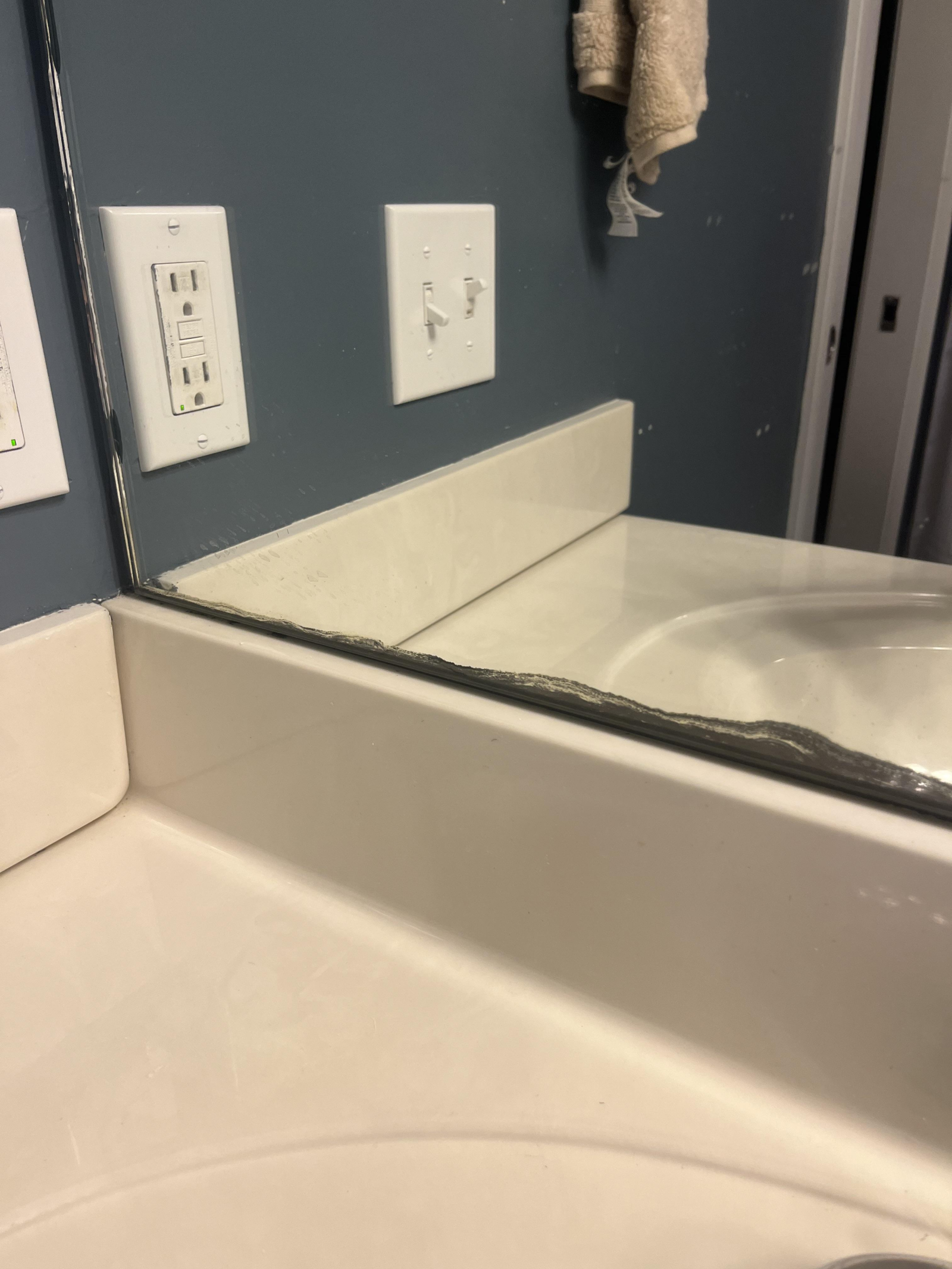
The photograph above shows a bathroom mirror with dark deterioration along its edge. The installation history raised concerns about the ordinary neutral silicone reportedly used behind the mirror.
However, dark edges can have more than one cause. The photograph shows the damage, but cannot establish the exact cause on its own.
What matters for the homeowner or installer is that this kind of deterioration is not simply mold or dirt on the front surface. Once the reflective layer itself has been damaged, cleaning the glass or replacing the perimeter seal will not restore the reflection. In most cases, replacing the affected mirror is the practical solution.
This is why preventing compatibility problems is so much easier than dealing with the results afterward.
For comparison, our EX230 acetoxy silicone is designed for compatible glass and other nonporous applications. Its acid-curing chemistry, however, makes it unsuitable as a general starting point for bonding coated mirror backs.
Mirror bonding calls for a product developed and evaluated for that application.
Alkoxy or Oxime: Which Neutral Cure Is Better for Mirrors?
One of the most common misunderstandings about silicone is that all neutral-cure products are essentially interchangeable.
They are not.
Two widely used neutral-curing systems are alkoxy and oxime. Both cure through reactions involving moisture, but they release different by-products during the process.
Alkoxy silicone releases alcohol as it cures.
Oxime silicone releases ketoxime compounds. Certain oxime formulations can cause discoloration when their cure by-products come into contact with susceptible metals such as copper or brass.
This difference is relevant to mirror applications because some mirror constructions contain vulnerable metallic layers beneath their protective coatings.
That does not mean the adhesive normally touches those layers. In a properly manufactured mirror, they are protected by backing materials. But damaged backing paint, exposed edges, or an unsuitable coating system can make compatibility more complicated.
| Cure type | Curing characteristics | What it means for mirror bonding |
|---|---|---|
| Alkoxy silicone | Releases alcohol during curing. | Commonly used in dedicated mirror adhesives. It avoids the particular oxime/copper discoloration concern associated with some formulations, but compatibility with the backing or safety film still needs to be confirmed. |
| Oxime silicone | Releases ketoxime compounds during curing. | Widely used in general-purpose neutral silicones. Some formulations can affect susceptible metals, so an unspecified oxime silicone should not automatically be treated as a mirror adhesive. |
In the markets we serve, many general-purpose neutral silicones are oxime-cure products.
When customers ask whether they can use their regular neutral silicone behind a mirror, my first concern is not simply whether the product is neutral. I want to know which curing system it uses, what kind of mirror is being installed, and whether the adhesive will actually come into contact with the backing.
There's another distinction that often comes up in these conversations. Sometimes installers say they have been using ordinary neutral silicone on mirrors for years without problems. But when we look more closely at the application, the mirror may be held by a frame or mechanical clips, with the silicone serving only as a perimeter seal.
That is quite different from using the same product to bond an entire frameless mirror to a wall.
It is also worth pointing out that oxime silicone is not universally unsuitable for mirrors. Some mirror manufacturers approve specific oxime-based adhesives for certain mirror constructions. Others have restrictions, particularly where particular backing systems or safety films are involved.
The takeaway is that neither “neutral cure” nor “alkoxy cure” should be treated as an automatic guarantee of compatibility. The actual mirror and the named adhesive product matter more than the category.
If you'd like a broader explanation of these curing systems, see our guide to neutral-cure vs. acetoxy silicone.
The Right Adhesive Depends on How the Mirror Is Installed
Not every mirror needs to be glued to a wall.
This is an important distinction because the requirements for an adhesive change depending on the role it plays in the installation.
A mirror that is mechanically supported may have very different adhesive requirements from one that relies on a direct bond.
| Installation method | How the mirror is supported | What to consider |
|---|---|---|
| Framed mirror or mirror cabinet | The frame, cabinet, or supplied hanging hardware carries the mirror. | Adhesive behind the mirror may not be needed. Any silicone used for sealing should be selected for that separate joint. |
| Clips, J-channel, or mounting rails | Mechanical components provide support or retention. | Determine whether silicone is being used for bonding, supplementary support, or only perimeter sealing. |
| Frameless mirror directly bonded to a wall | A compatible adhesive system bonds the mirror to the wall, with temporary support during curing. | Use a dedicated mirror adhesive suitable for the backing and wall finish. |
| Safety-film-backed mirror | An approved adhesive system and appropriate support are used. | The adhesive contacts the safety film, so compatibility with the film is just as important as compatibility with the mirror itself. |
| Tape-assisted installation | Tape may position or temporarily support the mirror while the specified adhesive develops strength. | Both the tape and adhesive must be suitable for the surfaces they contact. |
| Small mirror tiles | A product-specific bonding or mounting system is used. | Smaller dimensions do not automatically make general-purpose silicone compatible with the backing. |
For someone purchasing mirror adhesive in bulk, this distinction is especially useful.
A distributor supplying installers who work mainly with frameless bathroom mirrors may need a different product offering from one supplying companies that install framed mirrors or cabinet systems.
Understanding the application first makes it easier to recommend the right product rather than assuming every project needs the same cartridge.
Check the Mirror Backing and the Wall Finish Together
Once you've confirmed that the mirror will be bonded directly to a wall, the next step is to look at the two surfaces that will form the bond.
On the mirror side, identify whether the exposed surface is backing paint, a safety film, or another protective material.
This matters because an adhesive approved for painted mirror backing may not automatically be suitable for a plastic safety film. The film itself also needs to remain securely attached to the mirror.
The wall deserves just as much attention.
A clean, sound tile surface is very different from loose paint, dusty plaster, or damp board facing. Even when silicone bonds strongly to the surface, the installation can still fail if that surface separates from the wall beneath it.
For example, imagine bonding a mirror onto a poorly painted wall. The silicone may adhere perfectly well to the paint, but if the paint loses adhesion to the plaster, the entire bond can fail.
In that situation, changing to a stronger adhesive would not solve the underlying problem.
For bathroom installations, moisture is another consideration. A mirror in a humid bathroom is not necessarily exposed to the same conditions as one whose edges are frequently splashed with water.
Where water can reach the mirror edges or bonding area, the edge protection and installation details become important. The mirror manufacturer's guidance should determine how those conditions are handled.
Our kitchen and bath application guide covers related considerations for silicone in these environments.
For unfamiliar mirror constructions or wall finishes, a small compatibility trial can provide useful information before a larger installation.
Ideally, the trial should use the same mirror backing, wall finish, and surface preparation planned for the actual project.
It is also useful to observe where any failure occurs. An adhesive that separates cleanly from the backing presents a different issue from one that remains attached while the wall paint peels away.
These details provide more useful information than simply asking whether a product “sticks to mirrors.”
Bead Layout, Curing, and Support Matter Too
Choosing a suitable adhesive is only part of a successful mirror installation. The way it is applied also matters.
One-part silicone cures through exposure to moisture. For mirror bonding, the adhesive is commonly applied in beads rather than spread as a continuous layer over the entire rear surface.
A broad, fully spread layer between relatively impermeable surfaces can restrict the moisture path needed for proper curing.
Vertical adhesive beads are commonly recommended because they leave spaces between them and can help avoid trapping moisture.
However, there isn't one universal bead size or spacing that works for every mirror.
The appropriate layout depends on factors such as mirror dimensions, weight, the adhesive's properties, wall flatness, and the manufacturer's installation guidance.
The same applies to curing time. A cartridge's general curing information should not be used on its own to decide when temporary supports can safely be removed from a particular installation.
Support is another part of the installation that is easy to overlook.
For a directly bonded mirror, temporary supports such as blocks, braces, or suitable tape may be needed to keep the mirror in position while the adhesive develops strength.
Some installations also require permanent mechanical retention.
Large or heavy mirrors, overhead applications, and installations where a falling mirror could cause serious harm may need a qualified support design that includes clips, rails, channels, or other mechanical components.
Silicone's elasticity can help accommodate small differences in movement between compatible materials, but it cannot make a weak wall finish stronger or replace mechanical support where that support is required.
A well-planned installation considers the adhesive, the surfaces, the bead layout, and the support method together.
Where Vesta MI360 Fits into Mirror Bonding
For projects that require a dedicated silicone mirror adhesive, Vesta MI360 Mirror Adhesive is the product to evaluate.
MI360 is a premium, one-part alkoxy-cure silicone developed for mirror bonding applications, including compatible bathroom, dressing-room, and decorative mirror installations.
There are several reasons why this type of formulation can be useful for mirror installation.
First, its alkoxy-curing chemistry makes it different from the general-purpose oxime silicones commonly found in many markets. This avoids introducing the particular oxime/copper discoloration concern associated with some formulations, although the mirror backing still needs to be compatible with the finished adhesive system.
Second, MI360 has a low-odor formulation. This can be particularly useful for interior work in bathrooms, apartments, dressing rooms, and other spaces where strong curing odors would be inconvenient for installers or occupants.
Third, it forms an elastic bond after curing. Where the surfaces and installation are suitable, that flexibility can help accommodate small movements or vibrations without relying on a rigid adhesive joint.
These properties make MI360 a product worth evaluating for direct mirror bonding. They do not, however, mean it should automatically be used on every mirror or backing material.
Before approving it for a specific project, the mirror construction, any safety film, and the finished wall surface should be matched against the product's current technical information.
The technical data sheet should also be used to determine the appropriate bead dimensions, curing conditions, coverage, and temporary support requirements.
For projects involving larger or more demanding installations, the overall support design needs to be considered alongside the adhesive selection.
If you're sourcing mirror adhesive for a distribution business, installation company, or construction project, you can request the current MI360 technical documentation and discuss sample options from the MI360 product page.
Technical documents can be requested through our technical resources page.
What Information Helps Us Recommend the Right Mirror Adhesive?
If you're unsure whether MI360 is suitable for your application, you don't need to have every technical detail figured out before contacting us.
A few basic details about the mirror and its installation are usually enough to begin the discussion.
The most useful information includes:
- Mirror type and backing: The mirror manufacturer or model, if available, and whether the back has protective paint, safety film, or another coating.
- Mirror dimensions: The approximate width, height, thickness, and weight.
- Wall surface: Whether the mirror will be bonded to tile, painted plaster, board, or another finished surface.
- Installation environment: For example, a residential bathroom, dressing room, commercial interior, or another application.
- Mounting method: Whether the mirror will be directly bonded, mechanically supported, or installed with a combination of adhesive and support.
- Your purchasing requirements: Destination market, technical documents needed, and whether you're looking for samples, project quantities, or ongoing supply.
With this information, we can help assess whether MI360 is an appropriate product to evaluate, identify any details that still need confirmation, and provide the relevant technical documentation or sample options.
And if your mirror has a special backing or installation requirement that needs further verification, we'd rather clarify that early than recommend a product that may not be suitable.