
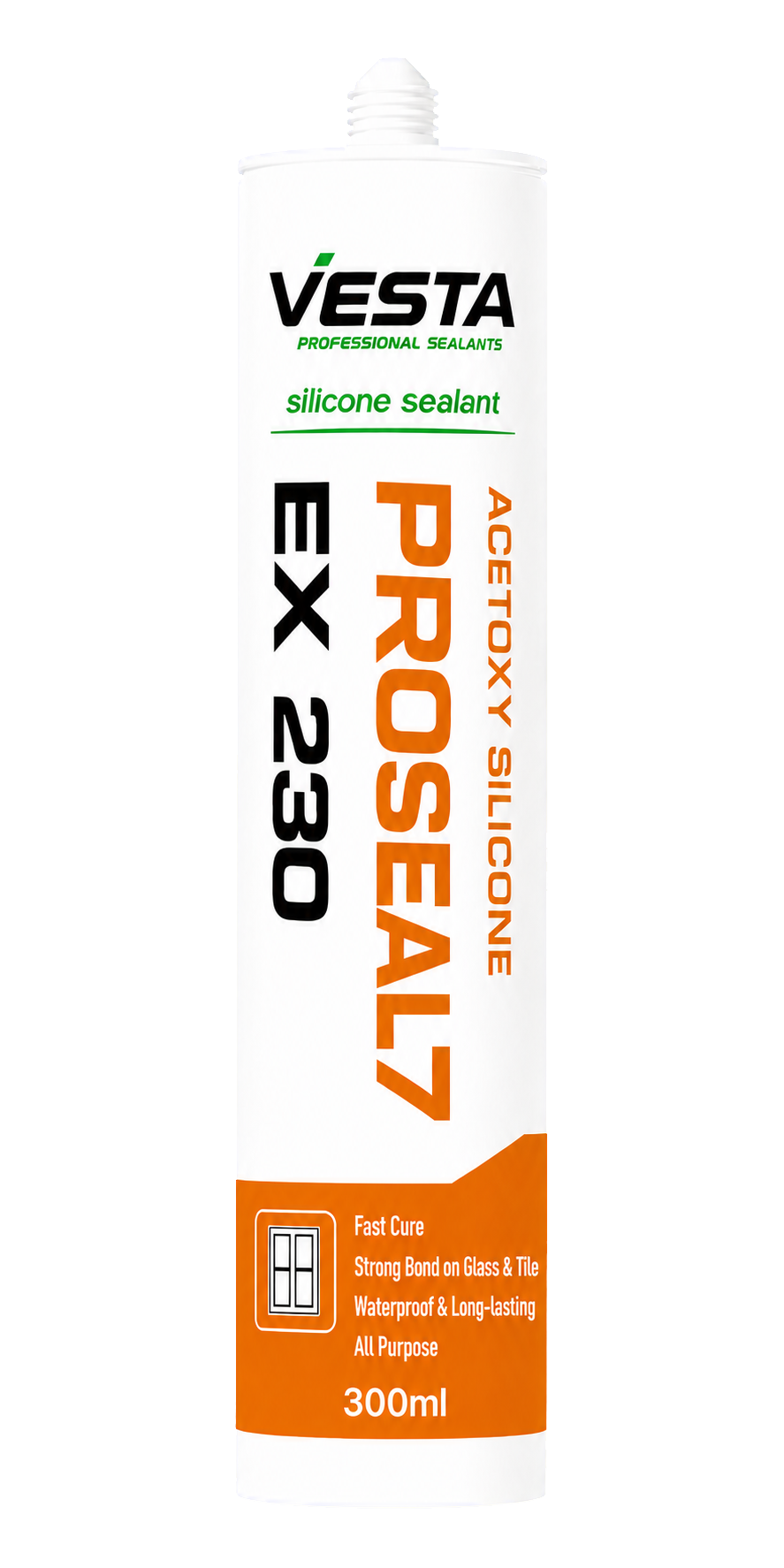
EX230 Fast-Cure
Acetoxy Silicone Sealant
Fast-cure acetoxy silicone
Fast handling for countertop, aquarium and glass bonding details.
EX230 is a one-component, fast-cure acetoxy silicone sealant for granite countertop installation, undermount sink bonding and sealing with a compatible stainless-steel sink rim, aquarium glass sealing and bonding, and selected compatible glass and non-porous assemblies. Its 6-minute tack-free time supports prompt tooling and efficient handling.

Cure systemOne-component acetoxy RTV
Tack-free result0.10 h · approx. 6 min
Primary surface fitGranite, aquarium & glass
Packaging300 mL cartridge
Product overview
Fast handling for countertop, aquarium and glass bonding details.
EX230 is a one-component, moisture-curing acetoxy silicone supplied as a uniform, fine non-sag paste. Its confirmed application scope includes granite countertop installation, undermount sink bonding and sealing with a compatible stainless-steel sink rim, aquarium glass sealing and bonding, and correctly prepared compatible glass, ceramic and selected non-porous assemblies.
- Granite countertop installation
- Undermount sink bonding and sealing
- Aquarium glass sealing and bonding
- Glass-to-glass sealing
- Compatible general glazing details
- Glazed ceramic and selected porcelain edges
- General-purpose non-porous sealing
Typical EX230 applications
Start with the actual project materials
Granite countertop installation, undermount sink bonding/sealing with a compatible stainless-steel sink rim, and aquarium glass bonding are confirmed application routes. Check the actual stone finish, sink finish and adjacent materials; test porcelain, coated aluminum, stainless steel outside that sink-rim scope and plastics on representative materials before approval.
Check substrate compatibilityTechnical data
EX230 data for product comparison.
Review the selected values below, then open Rev. 03 for the reported methods, conditions and complete product guidance.
| Property | Value | Basis / condition |
|---|---|---|
| Appearance | Uniform, fine paste | Visual inspection |
| Density | 0.96 g/cm³ | Measured result; density meter |
| Vertical sag | 0 mm | Reported GB/T 13477 method |
| Extrudability | Approx. 850 mL/min | Approved typical product value |
| Tack-free time | 0.10 h · approx. 6 min | Reported GB/T 13477 method; not full cure |
| Movement capability | ±25% | Confirmed product value; correctly designed joints and assemblies |
| Shore A hardness | 15 | Reported GB/T 531-92 method; cured sample |
| Tensile strength | 0.65 MPa | Reported GB/T 13477 method; use with approved joint design |
| Elongation at break | 200% | Reported GB/T 13477 method; not movement capability |
| Application temperature | +5°C to +40°C | Clean, dry substrate; +15°C to +25°C recommended |
Cure and application behavior vary with temperature, humidity, bead depth, exposed surface area and air circulation.
Quantity & shipping planner
Plan the EX230 order your way.
Start with cartons for a wholesale order, or use joint dimensions for a project quantity.
Calculation basis
EX230 calculations use a 300 mL cartridge, 24 cartridges per carton, 8.5 kg per carton, a 300 × 243 × 200 mm outer carton, 100 cartons per full pallet and 2,000 cartons per 20 ft load reference. CBM is the sum of outer-carton volumes. Confirm final packing and transport requirements before quotation.
Acetoxy cure & compatibility
How acetoxy cure affects substrate choice.
EX230 cures with atmospheric moisture from the exposed surface inward, releasing acetic-acid-type by-products with a characteristic vinegar-like odor. Provide ventilation and check the actual substrate for corrosion, staining and adhesion risks.
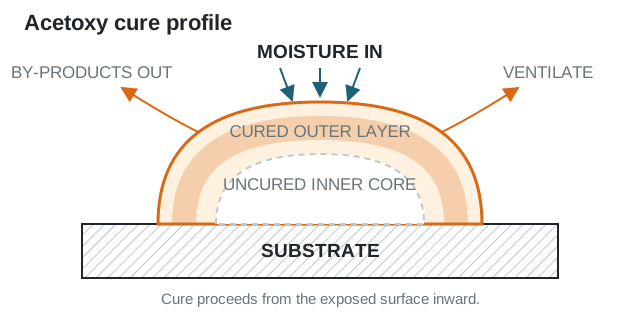
Understand the four EX230 cure stages.
“Dry,” tack-free, through-cure and return to service are different stages. Odor reduction is not proof that the interior has cured.
Tack-free0.10 h · approx. 6 minThe exposed surface no longer transfers material under the reported check.
Tooling windowApprox. 5–10 minComplete tooling before the surface skin develops at 23°C / 50% RH.
Through-cure progressApprox. 3 mm / 24 hTypical inward cure rate at 23°C / 50% RH.
Early protectionAt least 24 hAllow 48 hours in cold or dry conditions before planned water or movement exposure.
Provide ventilation during application and cure. Fully confined geometry can restrict moisture entry, slow interior cure and delay by-product release.
Check EX230 against your actual substrate.
Material names alone do not establish compatibility. Finish, coating, cleaner residue, porosity and adjacent materials can change adhesion, corrosion, staining or stress-cracking risk.
| Substrate group | Selection status | What to confirm |
|---|---|---|
| Clear float glass and glass-to-glass joints | Generally suitable | Clean thoroughly, verify glass treatment and use the approved joint and load design. |
| Glazed ceramic | Generally suitable | Remove soap, grease and processing residue, then confirm the actual glaze and cleaner. |
| Porcelain | Test before use | Use a representative specimen to check adhesion on the actual surface finish. |
| Anodized, painted or coated aluminum | Project test | Test the exact anodizing or coating, color, batch, cleaner and adjacent materials. |
| Granite countertop and compatible stainless-steel sink rim | Generally suitable | Generally suitable for granite countertop installation and compatible stainless-steel sink-rim bonding and sealing. |
| Stainless steel outside the confirmed sink-rim scope | Compatibility test | Test the actual grade and finish, including the effect of prolonged acid exposure under project conditions. |
| Marble, limestone, travertine and other natural stone | Test before use | Test the actual stone, finish, cleaner and adjacent materials before use. |
| Acrylic, polycarbonate, PVC and fiberglass | Compatibility test | Use representative specimens to check stress cracking, crazing, discoloration and adhesion variation. |
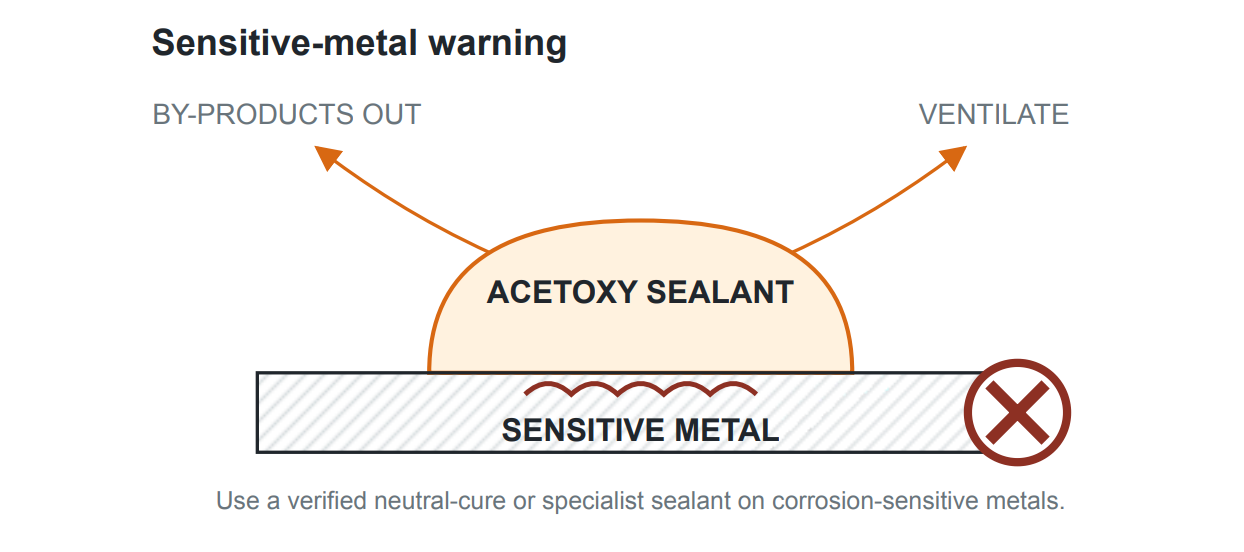
| Copper, brass, lead, zinc, galvanized steel and mild steel | Not recommended | Acetoxy cure can create corrosion or discoloration risk; select a verified neutral-cure or specialist product. |
| Concrete, mortar and cement board | Specialist product | Porosity and alkalinity make a compatible construction sealant the better choice. |
| Mirror backing, insulating-glass edges and laminated-glass edges | Not approved | Use only a product and glazing system approved for the exact mirror or specialty-glass assembly. |
Before approval: a quick adhesion result does not prove long-term compatibility. Test the actual finish, cleaner, primer and adjacent materials.
Prepare and apply EX230 in five steps.
- Confirm the chemistry.Verify that acetoxy cure is compatible with every substrate, finish and adjacent material, and that the joint or bonding requirement fits the approved assembly design. For the confirmed countertop route, also confirm the actual granite finish and sink finish.
- Prepare clean, dry bond faces.Remove dust, oil, grease, soap, old sealant, condensation and cleaner residue. Keep the substrate at least 3°C above the dew point.
- Control sealant depth.Use a compatible backer rod or bond-breaker tape where required to support two-sided adhesion and the approved joint geometry.
- Fill from the joint base.Keep the nozzle embedded in fresh sealant to maintain substrate contact and reduce incomplete filling or trapped air.
- Tool, ventilate and protect.Tool before skin formation, remove masking promptly, provide air movement and protect the fresh bead from water and movement during early cure.
Common application mistakes
Avoid application errors that can compromise seal performance.
Common application problems include incompatible surfaces, contaminated bond faces, poor ventilation and confusing tack-free with full cure.
The reported 6-minute value describes the exposed surface. Interior cure still depends on bead depth, temperature, humidity and air circulation.
Copper, brass, zinc, galvanized steel, mild steel and other sensitive metals may corrode or discolor during acetoxy cure.
“Glass,” “aluminum” or “plastic” does not identify the treatment, coating, grade or stress-cracking risk. Test the actual material combination.
EX230 needs clean, dry bond faces. Follow the current TDS for surface preparation; old silicone and residual film are not bond-ready surfaces.
A surface cap can leave air voids and incomplete substrate contact. Keep the nozzle in fresh material and fill continuously from the joint base.
Tool before skin formation, ventilate the work area and do not use odor disappearance as the only cure indicator.
For distributors and brands
Evaluate EX230 for a glass and general-purpose silicone range.
Share the intended substrates, color, 300 mL cartridge requirement, quantity and destination market. Vesta will review product fit, available packaging and the documents needed for your market before quotation.
Product FAQ
Common EX230 selection questions
What is an acetoxy silicone sealant, and where does EX230 fit?
An acetoxy silicone sealant is a moisture-curing silicone product that releases acetic-acid-type by-products and a characteristic vinegar-like odor during cure. EX230 fits compatible glass, aquarium glass, glazed ceramic and selected rigid non-porous bonding and sealing details. Ventilation and material compatibility checks are required.
Is EX230 a glass silicone sealant?
EX230 fits clean float-glass-to-glass joints, aquarium glass sealing and bonding, and compatible general glazing. Confirm the actual glass treatment, cleaner, joint design and project load role.
Can EX230 be used for aquariums?
Yes. EX230 is suitable for aquarium glass sealing and bonding when used with clean compatible glass, approved joint geometry and complete cure before water filling.
Can EX230 be used for a granite undermount sink?
EX230 has a confirmed application scope for granite countertop installation and undermount sink bonding and sealing with a compatible stainless-steel sink rim. Confirm the actual stone and sink finishes and the approved assembly design.
How fast does EX230 silicone sealant cure?
The reported tack-free result is 0.10 h (approximately 6 minutes). Typical through-cure progress is approximately 3 mm per 24 hours at 23°C and 50% relative humidity. Tack-free is not full cure. Lower temperature or humidity, greater bead depth and confined geometry can extend cure time.
Can EX230 be used on any non-porous surface?
No. Clear float glass and glazed ceramic are the primary starting points. Porcelain, anodized or coated aluminum, stainless steel and plastics need testing on the actual finish or grade. Low-surface-energy plastics such as PE, PP and PTFE are generally unsuitable without specialist review.
Which metals require caution with EX230?
Metal compatibility depends on the exact alloy and finish. Copper, brass, lead, zinc, galvanized steel, mild steel and other corrosion-sensitive metals are not generally recommended. Coated aluminum and stainless steel require project-specific compatibility checks.
Which EX230 package and colors are listed?
The current EX230 TDS lists a 300 mL cartridge and the colors black, white, grey and clear. Confirm required quantity, destination market and current document availability before quotation.
Technical documents
Review the EX230 TDS and document availability.
Open the current EX230 Technical Data Sheet. If you need an SDS, tell us the destination market and language so we can check document availability before handling or transport.
Technical Knowledge
Related insights

Does Silicone Sealant Need a Primer? How to Decide
Most routine silicone-sealant applications do not need primer when the product covers clean, sound and compatible surfaces. Learn what primer does, where it is normally...
Read Article
Silicone Sealant for Glass: A Buyer’s Selection Guide
There is no single best silicone for every glass joint. Start with joint role and the actual bond-line surface, then map adjacent materials and match...
Read Article
Does Silicone Caulk Expire? Shelf Life, Storage, and Batch Checks for Buyers
Unused silicone caulk can expire. Learn how to check product-specific shelf life, calculate remaining life, inspect a batch at receipt, and control opened or short-dated...
Read ArticleWhat Is RTV Silicone? Types, Gasket Makers and Buyer Checks
RTV often means a high-temperature gasket maker in automotive and maintenance work. See its common applications, how other RTV types differ and what buyers should confirm.
Can Silicone Sealant Be Used as an Adhesive?
Silicone sealant can bond panels and components when flexibility, compatible surfaces and supported curing fit the job. See suitable uses, stop conditions and Vesta product directions.

How Long Does Silicone Caulk Take to Dry? Cure Stages and Water Exposure
Silicone caulk has separate surface, through-cure and exposure milestones. Learn what changes cure time, how current Vesta model instructions differ, and what to check before water exposure.
Silicone Sealant vs Caulk: How Buyers Turn Labels Into Specifications
Caulk and sealant are not quality grades. Translate the local label into chemistry, joint role, substrates, exposure, paintability and document checks before approving a quote or sample.

Ready to evaluate EX230 for your market or application?
Share the substrate and finish, stone and sink details where applicable, joint size, load role, support method, exposure conditions, color, quantity and destination market. Vesta can review whether this fast-cure acetoxy silicone sealant fits the intended bonding or sealing use before quotation.
Include in Your Inquiry
1. Exact substrates and finishes
2. Joint size and load role
3. Color and package requirement
4. Quantity and destination market