

For silicone sealant for glass, there is no universal product for every glass joint. A silicone adhesive for glass may be doing very different work depending on whether the glass is mechanically retained, bonded in a non-structural assembly, sealed at an exterior perimeter, or used in a specialist glazing system.
Start with the job the joint must perform. Then identify the actual surface the silicone will touch, the second substrate, the other materials in the joint, the exposure and the evidence available for the exact product.
In our experience, buyers often start with a local habit—“acetoxy for glass” or “neutral for everything”—before they have named the joint. That shortcut can send a normal glazing question into the wrong product family.

Start with what the joint must do
The terms glass silicone sealant, silicone glass glue, silicone glazing sealant and glass window sealant can describe very different jobs.
Ask what the silicone is actually expected to do:
| Joint role | What the silicone is expected to do | First decision |
|---|---|---|
| Non-structural bonding | Hold a lightweight assembly or close a defined gap without carrying the building’s primary load | Confirm the exact surfaces, preparation and product scope |
| Mechanically retained glazing | Seal around glass that is held by a frame, stop or other mechanical detail | Review the perimeter role, movement, exposure and frame finish |
| Exterior weatherseal | Limit water and air entry while accommodating the designed joint movement | Start with an exact weather-resistant product document and the joint design |
| Structural glazing | Transfer designed building loads through an engineered silicone system | Stop the ordinary glass-sealant comparison and use the structural system owner |
| Aquarium or continuous immersion | Bond panels under hydrostatic load and remain suitable for the specified water environment | Stop and use a dedicated aquarium or immersion route |
The primary keyword is broad because the search result itself mixes different intents. A product page, a DIY window repair guide and a structural glazing document may all appear for similar wording while answering different questions.
The first useful output is therefore a named joint role, not a product name.
For window and door perimeter work, the Windows & Doors application guide can help define the opening and control layer before you compare a sealant. For facade systems, the Curtain Wall application guide owns the larger weatherseal and structural boundary.
Identify the glass and the surface the silicone will actually contact
“Glass” is not a complete compatibility description.
Start by recording the actual construction and surfaces involved:
- bare float, tempered, laminated, insulating or another glass construction;
- Low-E, reflective, ceramic-frit, easy-clean or another coating or treatment;
- the actual surface at the proposed sealant bond line;
- the second substrate, such as aluminum, a painted finish, gasket or another panel;
- indoor or outdoor exposure, water contact, cleaning, UV and expected movement.

The glass name alone does not always identify the material at the sealant interface. A coated, fritted, laminated or edge-processed glass assembly can place a very different surface in direct contact with the silicone.
| The project says | The sealant may actually contact |
|---|---|
| Clear or tempered glass | A bare glass surface |
| Low-E or reflective glass | The coating itself, an edge-processed area or another exposed glass surface |
| Fritted or spandrel glass | A ceramic or enamel-coated surface |
| Laminated glass | The glass face, a processed edge or an exposed laminate/interlayer detail |
| Easy-clean or self-cleaning glass | A treated surface whose exact chemistry may affect the compatibility review |
This is why “Low-E glass” is still not a complete substrate description.
Identify the exact glass or coating product, where the coating is located, whether the proposed sealant bead will actually contact it, and whether the glass manufacturer specifies any edge treatment for that construction.
Do not assume that every coated-glass edge should be handled the same way. Some systems may require coating removal in a particular bond area while others do not. The requirement depends on the exact glass construction, coating, sealant system and joint role.
If a coating has been removed by grinding or another edge-processing method, treat the surface that remains as the actual bonding surface. Do not automatically reduce it to generic “bare glass”: the processing method, residual coating and resulting surface condition can affect adhesion.
The same principle applies to ceramic frit. If the silicone lands on the fritted area, the relevant interface is the fritted surface rather than simply “glass.”
Laminated glass adds another layer to the decision.
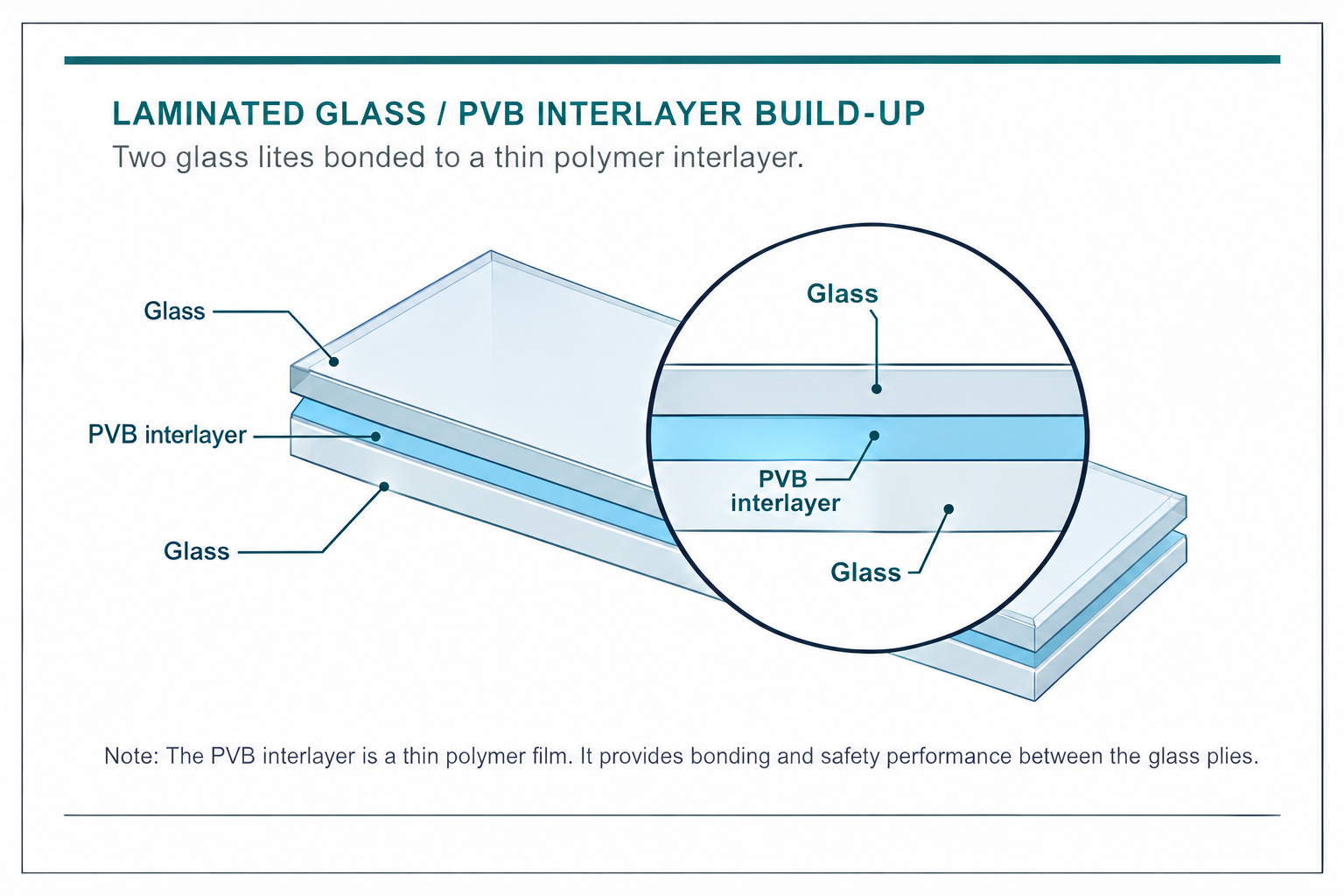
If a laminated edge or interlayer is exposed to the sealant, record that separately from the glass face and follow the appropriate compatibility route.
The practical question is therefore not only:
What type of glass is this?
It is:
What material will the silicone actually touch at the bond line?
Adhesion and compatibility answer different questions
Once the actual interface is identified, the next question is what needs to be verified.
Adhesion and compatibility are related, but they are not interchangeable.
Adhesion asks:
Will the silicone bond reliably to this actual surface?
For a glass assembly, that may mean adhesion to bare glass, ceramic frit, a coated surface, anodized aluminum or another material at the bond line.
Compatibility asks a different question:
Can these materials remain in contact without adversely affecting one another or the performance of the joint?
This becomes important when the silicone also contacts or sits beside glazing gaskets, spacers, setting blocks or other system components.
A material can be chemically compatible with a silicone without being a suitable bonding surface. Two materials may remain together without an adverse reaction while the silicone still develops inadequate adhesion.
The reverse shortcut is also risky. Good initial adhesion does not by itself establish long-term material compatibility. An incompatible adjacent material may later contribute to discoloration, cure disturbance, changes in sealant properties or loss of adhesion.
Ask what the project actually needs to confirm:
- Adhesion: Will the silicone stay bonded to the exact surface at the joint?
- Compatibility: Will materials that contact the silicone remain together without an adverse interaction?
- Both: Does the design require the silicone to bond to a material that must also remain compatible with it over time?
These questions describe the purpose of the check, not fixed categories of materials. The same material may require an adhesion review, a compatibility review or both depending on how it functions in the assembly.
Use representative project materials whenever confirmation is required. A result obtained with one glass coating, surface finish or accessory formulation should not automatically be transferred to another.
Map the whole glazing joint, not just two substrates
A glazing joint is often a material stack, not simply a glass-to-frame connection.
Once the bonding surfaces are identified, also record the materials that touch, border or help form the sealant joint.
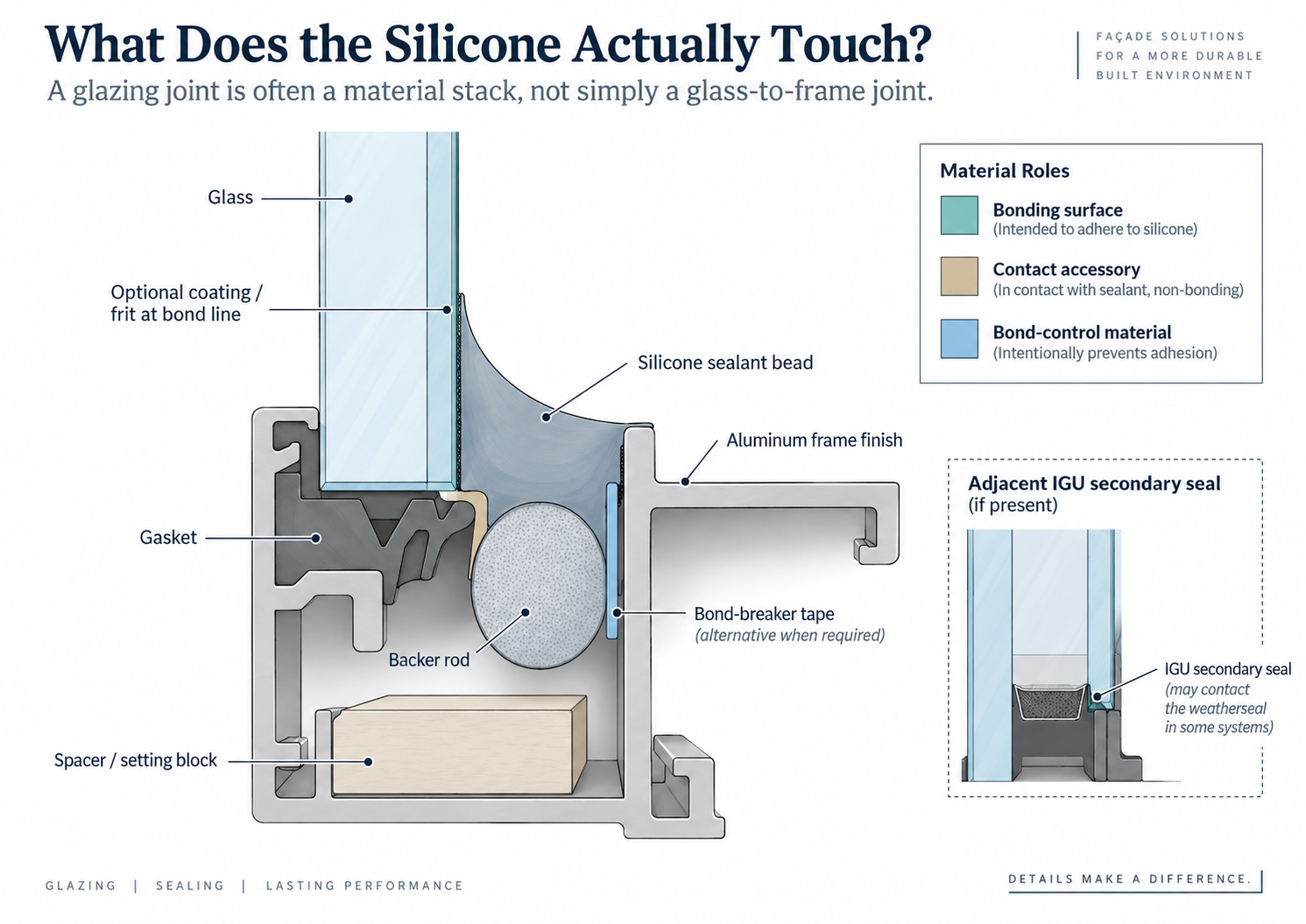
A glazing joint is a material stack: distinguish bonding surfaces, contact accessories and bond-control materials before checking compatibility.
| Material role | What to check | Typical examples |
|---|---|---|
| Bonding surface | The silicone is intended to adhere to this surface | Glass, coated glass, ceramic frit, aluminum finish |
| Contact accessory | The silicone may not need to bond to it, but contact must not adversely affect either material | Gasket, spacer, setting block, adjacent sealant |
| Bond-control material | The material helps control bead shape or intentionally prevents unwanted adhesion | Backer rod, bond-breaker tape |
A material does not need to be a bonding surface to affect the sealant.
A gasket, spacer or setting block beside the bead may still become part of the compatibility review if it contacts the silicone or can influence the joint over time.
The opposite is also important:
Not every material in the joint is supposed to bond to the silicone.
In many weather-sealing joints, a compatible backer material helps support application and control the sealant depth. Where the joint design uses a bond-breaker material, its role may be to prevent unwanted adhesion to the back of the joint.
Do not assume that every glass assembly contains all of these components. Their relevance depends on the actual glazing or weather-sealing detail.
For selection, map the whole joint rather than recording only “glass and aluminum.” Identify:
- what the silicone must bond to;
- what materials it will directly or indirectly contact;
- what controls the back or geometry of the joint;
- whether any adjacent gasket, spacer, block, tape, coating or other sealant changes the compatibility question.
This joint map gives a more useful basis for product review than two substrate names alone.
Acetoxy versus neutral: keep cure chemistry in its place
Acetoxy and neutral describe cure chemistry. They are useful screening labels, but they do not replace the joint and surface review above.
For a simple, compatible bare-glass, non-structural detail, an acetoxy product may enter the shortlist if the exact product scope, second substrate and preparation instructions fit.
For an exterior glass-to-frame weatherseal, especially where coatings, sensitive finishes or movement are involved, a neutral weather-resistant product may be a more relevant starting category.
But neither label alone answers whether the exact glass treatment, coating, second substrate, movement demand or adjacent materials are approved.
Likewise, clear silicone for glass is an appearance request, not evidence of adhesion, weathering, immersion or structural suitability.
For a full comparison of cure systems, see Neutral or Acetoxy Silicone? A Substrate-First Selection Framework. This page keeps the chemistry discussion limited to what is necessary for the glass joint.
Keep specialist applications behind hard stops
Some glass-related searches belong on another page or in a project-specific review:
| If the project involves | Do this |
|---|---|
| Primary load transfer in a facade | Stop the ordinary sealant selection. Use the structural glazing/system owner and project engineering route. |
| Aquarium panels or continuous water immersion | Do not substitute ordinary general-purpose or sanitary silicone. Use a dedicated aquarium/immersion product and design route. |
| Mirror silver backing | Treat the backing and protective layers as a separate compatibility question. Do not infer approval from a glass-face result. |
| IGU primary or secondary sealing | Use the controlled insulating-glass system route; an exterior perimeter product is not automatically an IGU seal. |
| Automotive glass or windshield bonding | Use the automotive adhesive system owner and its cure, safety and substrate evidence. |
These boundaries are not a claim that every specialist project fails with every general product. They are routing rules: the evidence, responsible system and approval path change.
A weatherseal can still interact with the IGU edge seal
A perimeter weatherseal and an insulating-glass secondary edge seal perform different jobs. The weatherseal manages the exterior joint and movement, while the secondary seal remains part of the IGU edge-seal system.
That functional separation does not always create a material separation.
In some curtain-wall, facade or glazing details, the perimeter weatherseal can directly contact or closely border the IGU secondary seal. When that happens, the interaction becomes part of the compatibility review.
Different functions do not mean no interaction.
If the two sealants meet in the actual assembly, confirm that the exact products and contact condition are compatible. Do not assume compatibility simply because both products are silicone or belong to the same general chemistry family.
At the same time, keep their roles separate. A compatible exterior weatherseal does not become an approved IGU secondary seal merely because it contacts one, and an IGU edge-seal product should not be substituted into the weatherseal role without its own documented application scope.
This check is only relevant where the actual glazing detail brings the two systems together. A normal frame-to-wall perimeter joint that does not contact the IGU edge system does not create the same question.
Build a glass-specific qualification check
Before a product reaches a sample or quote discussion, turn the project description into a defined glass joint.
| Check | Continue | Request | Stop |
|---|---|---|---|
| Glass construction | The construction is identified and the joint is not a specialist system | The proposal only says “glass” or omits the build-up | The project is an engineered structural, immersion, automotive or other specialist system |
| Actual sealant interface | The bond-line surface is identified as bare glass, coating, frit, processed edge, laminate edge or another treatment | The description does not say what the silicone will touch | A documented incompatibility is present |
| Second substrate | The material and exact finish are documented | The proposal only says “glass and aluminum” | The product limitation conflicts with the actual assembly |
| Adjacent materials | Gasket, spacer, setting block, tape, backer material, adjacent sealant or IG edge seal are recorded when present | The joint stack is incomplete | Required contact compatibility cannot be established |
| Joint role and retention | The role is a defined non-structural bond, mechanically retained glazing detail or weatherseal | The role or retention method is unclear | Structural or another specialist system is involved |
| Exposure and movement | Interior/exterior exposure, UV, water, cleaning, temperature and movement are documented | One condition or movement basis is missing | The stated product limit conflicts with the project |
| Evidence path | The exact product document and any representative check are defined | The TDS, test basis or project review is missing | The responsible system requires another route |
A missing field is a question to resolve, not permission to borrow a result from another glass type, coating or product.
Where Vesta products may enter the shortlist
Only after the glass joint has been classified should a Vesta model enter the conversation.
| Vesta route | Where it may enter | What this page does not claim |
|---|---|---|
| EX230 Acetoxy Silicone | Compatible lightweight, non-structural glass-to-glass or glazed non-porous details within the current product scope | Aquarium safety, permanent immersion, structural glazing, mirror backing, natural stone or universal coated-glass approval |
| WR550 Weather-Resistant Silicone | Compatible non-structural exterior glass/frame weatherseals where the actual surfaces, movement and exposure fit the current document | Structural load transfer, IGU secondary sealing, fire rating, permanent immersion or universal Low-E compatibility |
These two models are not simply an “acetoxy versus neutral” contest. Their documented application roles differ.
For the broader cure-system comparison, use the Neutral or Acetoxy Silicone guide. For exact model documents, use Vesta Technical Resources.
For window perimeter or facade work, pair the product document with the Windows & Doors or Curtain Wall application owner.
Frequently Asked Questions About Silicone Sealant for Glass
Can silicone sealant bond glass to glass?
Yes, for compatible non-structural applications, silicone can bond glass to glass. But the exact glass surface still matters.
Check whether the glass is bare, coated, fritted, laminated or otherwise treated, and confirm the joint role, movement and exposure. Structural glazing, aquariums and continuously immersed assemblies require dedicated product and system routes rather than a general glass-bonding assumption.
Does silicone stick to Low-E or coated glass?
It can, but “Low-E glass” is not enough information to approve a sealant.
Identify the exact coating, where it is located, whether the silicone will actually contact it, and whether the glass manufacturer requires edge processing or another preparation method.
Do not assume that neutral-cure silicone automatically solves the question. The actual bond-line surface and the exact product evidence still control the decision.
What is the bond line in a glass sealant joint?
The bond line is the actual interface where the silicone is expected to adhere.
That surface may be bare glass, a Low-E or reflective coating, ceramic frit, an edge-processed area or an aluminum finish.
When evaluating adhesion, identify the material actually present at the bond line rather than relying on broad descriptions such as “glass” or “glass and aluminum.”
What is the difference between adhesion and compatibility?
Adhesion asks whether the silicone will bond reliably to a surface.
Compatibility asks whether materials can remain in contact without adversely affecting each other or the joint.
A material may be compatible with silicone but still provide poor adhesion. Good initial adhesion also does not automatically prove long-term compatibility.
Depending on the assembly, a material may therefore require an adhesion check, a compatibility check or both.
Does every glass sealant joint need a backer rod?
No.
Backer rod is commonly used in weather-sealing joints to support application, control sealant depth and help prevent unwanted bonding at the back of the joint.
Other details may use bond-breaker material, gaskets, spacers or a different joint configuration altogether.
The correct question is not whether every glass joint needs backer rod, but where the sealant should bond and what joint geometry the design requires.
Can a perimeter weatherseal contact an IGU secondary seal?
Yes, in some curtain-wall, facade and glazing details the two may contact or closely border each other.
They still perform different functions: the perimeter weatherseal manages the exterior joint, while the IGU secondary seal remains part of the insulating-glass edge system.
If they meet in the actual assembly, check compatibility between the exact products. Contact does not make the two sealants interchangeable.
Is acetoxy or neutral silicone better for glass?
Neither is universally better.
Acetoxy silicone may suit some compatible, non-structural bare-glass applications. Neutral silicone may be a more relevant starting point for exterior weathersealing, sensitive finishes or coated assemblies.
The final choice still depends on the actual surfaces, joint role, exposure and product documentation.
For the full comparison, see Neutral or Acetoxy Silicone? A Substrate-First Selection Framework.
Send the actual glass-joint details
For a useful application-support review, send the information that defines the real joint:
- joint role and whether the glass is mechanically retained;
- exact glass construction and any coating, frit, treatment or laminated edge involved;
- the surface the silicone will actually contact;
- second substrate and exact finish;
- any gasket, spacer, setting block, backer material, tape, adjacent sealant or IG edge seal that contacts the joint;
- indoor or outdoor exposure, UV, water, cleaning and expected movement or load;
- any structural, immersion, IGU, mirror or automotive condition;
- exact product/model and current document revision if a candidate is already under review;
- project standard, sample or test requirement, quantity and packaging question where relevant.
Vesta can identify the relevant current product document and point out which glass-surface, adhesion, compatibility or project-review inputs are still missing.
This guide does not create structural, aquarium, mirror, IGU or automotive approval from an incomplete description.
To request a review, send the actual application details.