
Silicone weatherseal is one of the key sealing materials to evaluate for an outdoor capsule house or mobile prefab unit. It is a strong starting point for compatible, non-structural exterior joints around coated aluminum trim, glass-to-frame perimeters, and exterior window and door frames.
Roof laps, membranes, module connections, drainage paths, service penetrations and fire-rated joints need a different answer. Those details may require butyl, tape, gaskets, flashing, polyurethane, hybrid sealants or a specialist system.
So what sealant does a capsule house need? Start with the joint’s job. If you do not know whether a gap is an exterior weatherseal, a gasket, a membrane transition, a drainage opening or a rated assembly, do not choose the chemistry from the shell description alone.
In practice, capsule house sealant means the sealing package for an outdoor enclosure—not a single cartridge. The exterior weatherseal may use silicone, while other control layers use their specified materials.
In our experience with mobile capsule units, outdoor exposure and the number of enclosure interfaces make weathersealing a recurring procurement question, especially around compatible exterior joints. That is why the practical buying sequence is: identify the joint, match the sealing system to its job, then compare products.
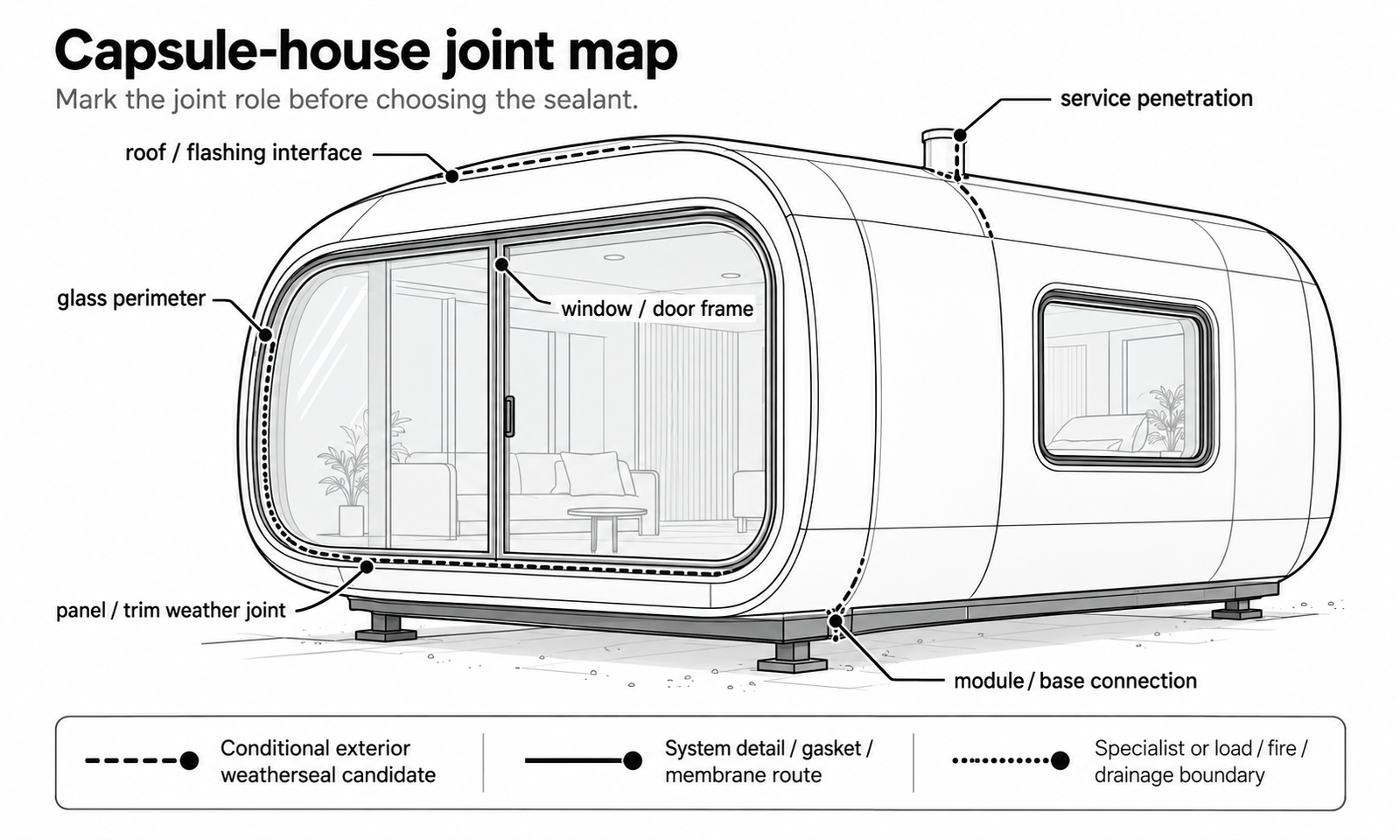
What sealant does each capsule-house joint need?
Use this table to decide what to check next. Conditional means weatherseal silicone is a reasonable product to evaluate after the listed checks. System-dependent means the drawing or system owner controls the material choice. Specialist boundary means ordinary exterior weatherseal silicone is not the right product to choose first.
| Capsule-house area | Joint role to establish | Likely next choice | First check |
|---|---|---|---|
| Aluminum shell to exterior trim | Exposed weather joint, concealed lap or attachment | Conditional weatherseal silicone for the designated exposed joint | Exact extrusion section, both bond faces, fastening and movement |
| Anodized or powder-coated aluminum | Sealant bonded to a finish, not simply bare metal | Conditional after actual-finish qualification | Coating/process identity, production sample and preparation |
| Glass-to-aluminum perimeter | Exterior weather bead separate from glass retention | Conditional only with glazing approval | Glass surface/coating, frame finish, IG edge, drainage and retention |
| Window and door perimeter | Outer rain seal versus rough-opening air seal | Conditional at the designated exterior bead | Head/jamb/sill detail, flashing and drainage exits |
| Exposed panel-to-panel butt joint | Weather joint, possibly over a drained cavity | Conditional where the panel detail designs it | Profile, backing, movement and termination continuity |
| Concealed panel lap or metal-roof joint | Lap, vapor/air seal or water-shedding assembly | System-dependent | Panel/roof maker’s section and specified tape, butyl, gasket or mastic |
| Roof flashing, membrane and drain | Layer transition or primary water-control detail | System-dependent | Membrane/roof detail, compatible accessory and drainage path |
| Module, mating or marriage line | Structural connection plus air/weather layers | System-dependent | Assembly sequence, movement, gasket/tape and responsibility split |
| HVAC, electrical or plumbing penetration | One or more control layers, possibly fire-rated | System-dependent or specialist | Penetration schedule and listed/approved system where required |
| Bathroom or kitchen finish joint | Sanitary finish joint versus primary waterproofing | Conditional only for the designated finish | Wet-area assembly, drain and transition details |
The table gives you a first sealing-system shortlist, then shows where silicone can enter the decision and where you need another drawing or system document first.
Start with the capsule-house assembly, not the shape
“Space capsule house” and “mobile capsule” describe a product category, not a shared bill of materials. Public capsule-house specifications commonly combine a coated aluminum exterior, insulated glazing, windows and doors, integrated services and wet areas; delivery may be one piece or split for site assembly. These are recurring configuration patterns, not a universal joint schedule. The actual coating, roof build-up, glazing retention and module-line construction still have to come from the unit drawing.
Before asking for a capsule house sealant, make a model-specific list:
- frame: galvanized steel, painted steel, aluminum or another structure;
- exterior skin and trim: exact alloy, coating or finish on each bond face;
- glazing: glass type, frame, gasket, insulated-glass edge and drainage path;
- openings: window and door perimeter, flashing, pan/end-dam and rough-opening layers;
- roof: panel profile, laps, closures, flashing, membrane, drains and intentional weeps;
- delivery: one-piece unit, split unit or site-assembled modules;
- penetrations and wet areas: HVAC, electrical, plumbing, hatch, shower and kitchen transitions.
Because published specifications describe different configurations and delivery methods, use the drawing for the actual unit instead of assuming that one capsule-house construction applies to another.
Where weatherseal silicone fits best
Coated-aluminum panel and trim joints
An exposed joint between an aluminum shell and exterior trim may be a reasonable starting point for a weatherseal-silicone evaluation when the detail is non-structural and the sealant bonds to the actual finish. “Aluminum shell” is not enough. Powder-coated, anodized and liquid-coated faces can present different adhesion questions, and a visible color does not identify the hidden extrusion face.
Use the silicone sealant for aluminum and finish guide for the deeper finish-selection task. Before you treat a product as a candidate, collect the extrusion section, finish/process identity, actual production sample, joint geometry, backing and expected movement.
Glass-to-aluminum perimeter weatherseals
The exterior bead around glass and an aluminum frame can be an exterior weather joint, but it is separate from glass retention, insulated-glass edge sealing and structural glazing. Check the glass surface or coating, frame finish, edge-seal location, drainage and retention method.
If the bead carries permanent load or belongs to an engineered structural-glazing process, stop and use the Curtain Wall application guide or the project’s glazing-system owner. An insulated-glass factory edge seal is a different joint from an exterior caulk bead.
Exterior window and door perimeters
The outer weatherseal at a window or door frame may be a silicone candidate when the opening detail designates that layer. It does not replace the rough-opening air seal, flashing, pan, end dam, gasket or drainage path. PNNL’s fully flashed window and door guidance and rough-opening air-sealing guidance show why these layers should be kept distinct.
For detailed opening decisions, see exterior window and door sealing and identify which opening layer you are actually trying to seal.
After those checks, WR550 weather-resistant silicone can be considered for a compatible, non-structural exterior weatherseal. The actual finishes, adjacent materials, joint geometry and system detail still decide whether the product remains in scope.
Roof, module and penetration details need a different sealing system
Roof laps, flashings, membranes and drains
Usually not by default. Roof details are where “just use silicone” most often breaks down. A metal-panel roof may use non-skinning butyl, tape, urethane, closures, gaskets and mechanical assembly at different locations. A PVC, TPO, EPDM or bituminous membrane may require a welded seam, compatible flashing or a manufacturer-approved accessory. A roof drain or concealed drainage path has a water-management role that an exposed bead cannot replace.
For detailed roof selection, use the roofing and facade application guide. Ask for the roof profile, slope, flashing section, membrane grade, drain detail and exact transition before a product is discussed.
Do not fill an intentional weep, ventilation opening or drainage path simply because it looks like a gap. Its opening may be part of the pressure, drying or water-shedding design.
Module-to-module, mating or marriage-line joints
Not by default. A split or disassembled capsule creates a handoff question; it does not tell you which product belongs at the module joint. The connection may combine structural fasteners, a gasket, tape, membrane, backing, air seal and an exposed weather bead. The correct material and sequence depend on the actual section and on what is completed in the factory versus on site.
Ask for the assembly sequence, movement requirement, gasket or tape details, exterior weather layer and responsibility split. If the line is structural, fire-rated or part of a tested modular system, ask the system owner for the approved detail. A split-delivery description tells you to investigate the site handoff; it does not establish a particular marriage-line design.
HVAC, electrical, plumbing and fire-rated penetrations
Do not choose ordinary weatherseal silicone first. A service penetration can cross the air, water, thermal and fire-control layers at once. PNNL’s air-sealing guidance for plumbing and piping is a useful envelope reference. Where a rated assembly is involved, use a matching listed firestop or penetration system; a weatherseal silicone bead is not a firestop selection.
What is finished in the factory, and what is checked on site?
Do not turn transport into a universal resealing interval. Use a handoff plan instead.
| Stage | What to verify | Record to carry forward |
|---|---|---|
| Factory assembly and QA | Joint identity, approved material, surface preparation, geometry, cure/handling condition and drainage | Model/drawing reference and controlled QA record |
| Pre-shipment close-out | Exposed beads, closures, gaskets, labels and approved repairs | Shipment handoff record and photographs |
| Arrival inspection | Handling-visible damage, opened joints, displaced trim, blocked drainage and specified seal condition | Photos and exception list; no automatic re-caulking |
| Site connection and commissioning | Site-only interfaces, module lines, penetrations, roof transitions and approved repairs | Installer/system-owner approval and close-out record |
Transport and handling are reasons to inspect the specified joints. Do not re-caulk every delivered unit unless the approved detail calls for a repair.
What to check before choosing silicone
For a joint that still looks suitable for a weatherseal-silicone check, give the supplier these seven pieces of information:
- Confirm the role. State that the bead is an exposed, non-structural weatherseal. If it carries load, controls a rated penetration, forms the primary membrane or replaces a gasket, do not choose silicone yet.
- Name both bond faces. List the actual aluminum, steel, glass, coating, gasket, tape, membrane or adjacent finish—not only “metal shell.”
- Describe geometry. Provide joint width/depth, backing, bond-breaker conditions, movement expectation and whether the joint is a lap, butt, corner, glazing perimeter or transition.
- Describe exposure. Note exterior UV/rain, splash, retained water, wet-area use, temperature range and drainage. Keep temporary wetting separate from permanent immersion.
- Check the current document. Use the exact product page and TDS for the market and revision under review. Do not transfer a claim from another model, chemistry or region.
- Plan qualification. Agree with the supplier or system owner on adhesion, compatibility, preparation, primer/mock-up and cure/handling checks.
- Assign inspection. Decide who records factory release, arrival condition, site repair and final approval.
If the joint needs controlled depth or backing, see when to use backer rod. Backer rod controls geometry; it does not determine product compatibility.
When silicone should be ruled out or paused
Pause ordinary exterior-weatherseal selection when:
- the joint carries structural load or permanent glass retention;
- the roof, flashing, drain or membrane detail names a different system;
- the joint depends on a compression gasket, preformed tape or closure;
- a fire-rated penetration or tested assembly is involved;
- the coating, membrane, gasket or adjacent material is unknown;
- the visible seam may actually be a weep, ventilation opening or drainage path;
- the drawing does not identify movement, backing, water direction or responsibility;
- the request is for universal compatibility, permanent immersion, service life or automatic resealing.
Pause here because the information is not strong enough to choose a product. That does not make butyl, PU, SMP, a hybrid, a gasket or silicone universally better; it tells you to follow the controlling detail first.
Which sealant should you consider first?
Once a joint passes the screen above, start with a neutral-cure, weather-resistant silicone intended for compatible, non-structural exterior weatherseals. Do not treat an interior general-purpose caulk, a sanitary sealant or a structural-glazing product as interchangeable with that job. A capsule house stays outdoors: UV and rain attack exposed beads, temperature changes and transport create movement, and one enclosure may bring coated aluminum, glass, frames and adjacent accessories together. The product must therefore match the weather exposure, movement-joint role and actual surfaces.
If you can evaluate only one silicone product first for those exposed weatherseal joints, we would recommend WR550 weather-resistant silicone. WR550 is Vesta’s neutral-cure weather-resistant route for compatible facade, roofing-detail and window-frame perimeters and movement joints. That makes it a sensible first product to compare for a capsule-house weatherseal: it addresses the outdoor exposure and movement question before you complete the project-specific compatibility check.
This recommendation applies only to the joint role described above. WR550 is not being selected here as a roof-membrane adhesive, structural-glazing seal, firestop, drainage plug or permanent-immersion product. Send the joint details below so the actual finish, geometry and adjacent system can be checked against the product scope.
What to send a sealant supplier before asking for a recommendation
Use the Vesta sample-request path and include:
- capsule-house model, joint location and the joint’s intended role;
- a drawing, section or clear photographs from more than one angle;
- both substrates, exact finishes/coatings and any repair or primer history;
- joint dimensions, backing, movement or specification requirement;
- exterior, interior, splash, wet-area, roof or drainage exposure;
- adjacent roof, flashing, membrane, gasket, tape, coating and fastener materials;
- whether the joint is structural, fire-rated, waterproofing-primary, air-sealing or only weatherseal;
- factory, shipment, arrival or site stage;
- destination market and required technical documents;
- sample, packaging, quantity and color requirements.
With those inputs, Vesta can compare a compatible non-structural weatherseal proposal with the current WR550 evidence, point out missing information and tell you when the joint needs another qualified system. This is application support, not engineering approval or a promise of universal compatibility.
FAQ
Can silicone sealant be used on an aluminum capsule house?
Yes, for a designated non-structural exterior weather joint—after you check the exact aluminum finish, adjacent materials, geometry and exposure. The shell label alone is not enough; handle structural, glazing, roof and membrane roles separately.
Should silicone be used on capsule-house roof joints?
Not by default. First identify the roof profile, flashing, membrane, closure, drain and specified seal. The controlling detail may require butyl, tape, urethane, a membrane accessory, gasket or another system.
Does a capsule house need resealing after delivery?
There is no universal capsule-house resealing schedule established by this research. Inspect the specified joints and document transport or installation exceptions; repair only under the approved system/detail.
Is a window perimeter bead the same as a glass edge seal?
No. An exterior frame weatherseal, a rough-opening air seal, a gasket, an insulated-glass edge seal and a structural-glazing bond can occupy different roles. Use the window/glazing detail that identifies the layer.
Conclusion
The right capsule house sealant becomes clear when you identify what the joint has to do. Keep compatible non-structural exterior weatherseals in the silicone decision, and send roofs, membranes, module connections, penetrations, glazing retention and rated assemblies to the systems that control them.
For an initial application check, send your capsule-house joint details with the drawing or photo, both substrates and finishes, geometry, exposure, adjacent systems, project stage and document or sample requirements.