
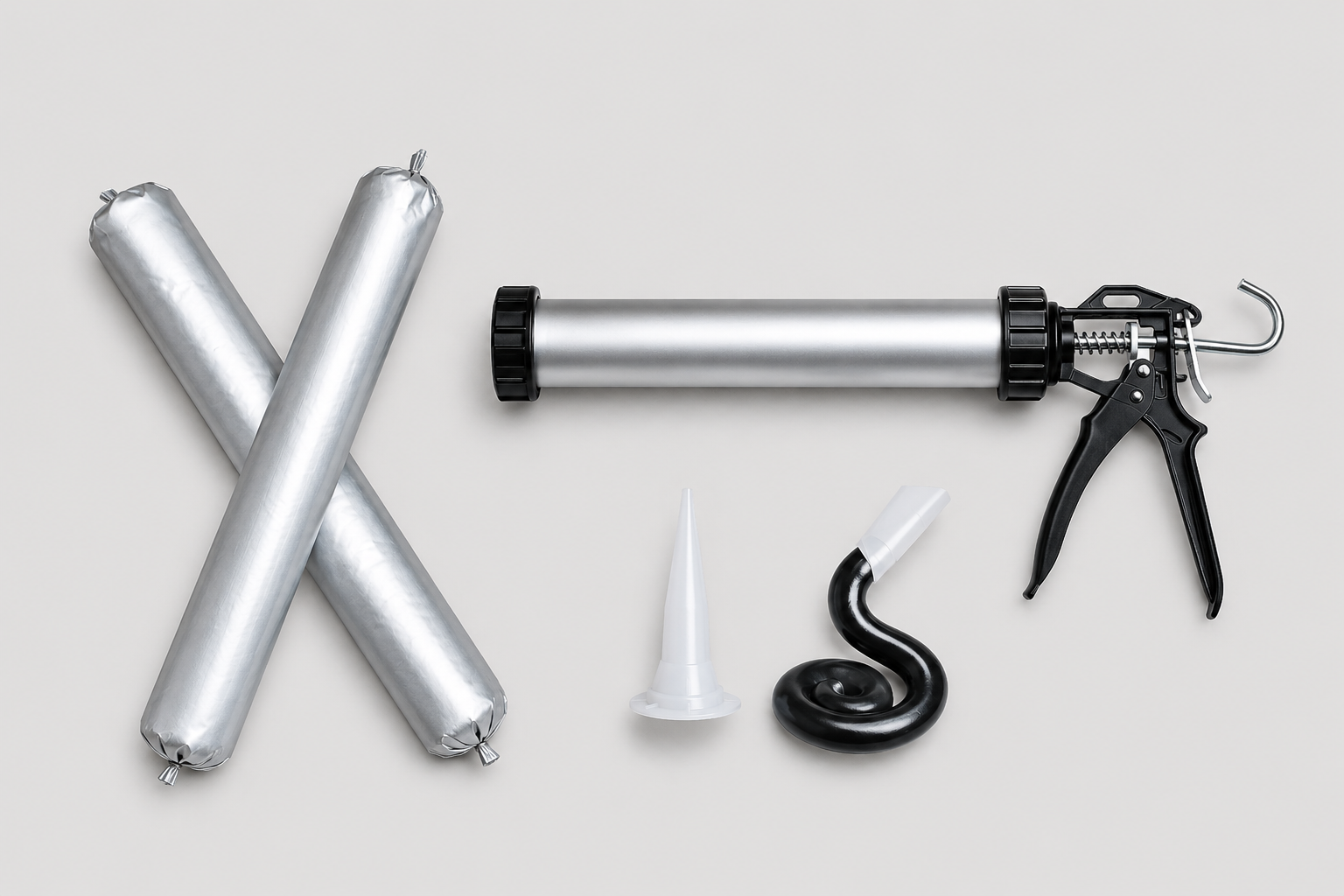
When a distributor compares cartridge vs sausage sealant, a cartridge is often the simpler starting point for broad distribution, mixed customer orders or occasional work. A sausage pack can make more sense for higher-volume dispensing when the customer has the compatible gun, the pack size is available, and the product and supply route are confirmed.
Neither format is automatically better. The decision is about the complete order: what your customers use, what equipment they already own, how often they reload, how you stock and receive the goods, and whether the requested format is documented for that product. A larger pack does not change the sealant’s cure chemistry, substrate limits or project approval requirements.
What are cartridge and sausage sealant packs?
A cartridge is a rigid prefilled container loaded into a cartridge gun. The gun pushes a plunger against the back of the cartridge and forces the sealant through a cut nozzle. It is a familiar format for many general-distribution, maintenance and smaller-job customers, but the word “cartridge” does not tell you the volume or whether a particular gun will accept it.
A sausage pack is a flexible foil pack sealed at both ends. It is loaded into a compatible sausage gun or a tool designed for the specific pack system; the plunger and end cap compress the flexible pack as material is dispensed. You may also see “foil pack,” “unipac,” “soft pack” or the buyer phrase “sausage tube caulk.” Ask for the physical format and declared net content instead of treating these terms as interchangeable.
The package is one component of a dispensing system. A Sika tool guide, for example, lists separate capacity ranges for cartridges and 600 mL sausage unipacs. That is useful evidence that pack volume and gun design must be checked together, not a universal compatibility rule for every brand or model.

What changes for a distributor when the format changes?
The cartridge vs sausage sealant choice changes five distributor decisions: workload, equipment, order pattern, stock and receiving.
1. Customer workload and reload frequency
Start with the work your customer actually does. A maintenance buyer who sells a few cartridges at a time has a different requirement from a façade contractor dispensing long, repeated joints every day. The second customer may value fewer changeovers, but that benefit only exists if the product, pack volume and gun system line up.
Ask for the job pattern in plain language:
- occasional repairs or regular maintenance;
- mixed orders across many customer types;
- repeated window, door, panel or perimeter work;
- one project with a defined application and quantity.
Do not turn “higher volume” into a fixed linear-meter threshold. Use the customer’s expected work and current tools to decide whether the larger pack is worth stocking.
2. Dispensing gun and loading requirements
Cartridge and sausage packs do not load the same way. A cartridge needs the correct cradle, plunger and nozzle arrangement. A sausage needs a barrel or chamber sized for the pack and a plunger that compresses the flexible sleeve correctly. Some tools can be converted or fitted with different components; that is a tool-specific fact, not a safe assumption.
Before quoting a sausage format, ask the customer for the gun model, barrel capacity, plunger arrangement and nozzle connection. If the customer has not chosen a gun, confirm the pack size first and test the complete loading setup. A gun labelled “400 mL” is not enough information if the product is a rigid cartridge, a 400 mL foil sausage or a different soft-pack system.
3. Order pattern and customer mix
A distributor may need one format, both formats or neither yet.
Cartridges are often easier to explain across a mixed customer base because the format is familiar and the product can be sold into standard cartridge-gun workflows. Sausages may fit a defined professional customer segment that already stocks compatible guns and buys repeated packs for the same type of work.
Packaging economics also matter. In our packaging and supply experience, a foil sausage can be more cost-effective than a rigid cartridge because the foil body and end seals cost less than rigid plastic cartridge components. Treat that as a packaging-cost advantage, not a promise that every delivered order will have a lower total cost: the gun, carton, freight, labor, storage and customer usage can change the result.
For a DIY household user or a customer who uses only a small amount at a time, a cartridge is usually easier to keep, close and reuse for the next job. For a large engineering project or a customer dispensing continuously, a foil sausage is usually the more natural fit, provided the compatible gun, pack size and product details are confirmed.
If you serve both groups, separate the SKU and customer logic. Do not place a cartridge and sausage under one vague “tube” description. Keep the product model, package format, declared net content, customer equipment and intended application connected in the quote and stock record.
4. Inventory, cartons, pallets and receiving
Pack format changes the physical receiving check. The buyer needs to know what should arrive, how it is identified and how a mismatch will be handled. Confirm the carton and pallet arrangement for the product and market rather than copying a different model’s packing count.
At receiving, compare the delivered goods with the approved order record:
- product model and cure type;
- cartridge or foil sausage format;
- declared net content;
- carton and pallet count;
- label language, warnings and product identity;
- lot or batch coding;
- visible damage, leakage or opened packaging.
Keep packaging with the product and document revision in the same receiving record.
5. Partial use and storage instructions
Opening and storage instructions depend on the product, pack system and closure. Check the label, TDS and applicable SDS for the requested format, storage range, shelf-life statement and handling limit.
One issue we pay close attention to is the end seal. In our experience with sealant packaging and supply, a high-quality foil sausage pack with intact end seals can often remain suitable for unopened storage for 12 to 18 months or longer. After temperature changes, we have found foil end seals more dependable than some rigid plastic cartridge seals, so pack quality and seal condition are separate supply checks.
Pack size is not a quality grade. Rigid cartridges may be quoted in 240, 260, 280 or 300 mL sizes, while foil sausage packs may be quoted in 500, 550, 590 or 600 mL sizes. We have seen orders where the commercial description and actual net content did not match: a 280 mL pack presented as 300 mL, or a 500 mL pack presented as 600 mL. Before release, compare the supplier’s label, quotation, packing list, carton marking and approved sample; inspect incoming samples when capacity is commercially important.
If your customers frequently open a pack and return to it later, make that use pattern part of the product discussion. If they empty packs in one continuous run, the priority may be loading speed and equipment fit. The format choice should follow the real use, not a generic claim about waste or convenience.

A distributor decision table with a next action
| Situation | Starting direction | Next action before you quote or stock |
|---|---|---|
| Mixed customers, occasional use or standard cartridge guns | Cartridge is often the simpler starting point | Confirm the product, declared net content and cartridge details; check model-specific carton and market availability. |
| A defined customer group already uses compatible sausage guns for repeated work | Sausage may fit the workload | Record the gun model, barrel/pack capacity, plunger and nozzle arrangement, then match them to the product pack. |
| The buyer says “tube,” “sausage tube caulk” or “cartridge” without a photo or document | Do not choose yet | Ask for the package photo, net content, model, product document and gun details. |
| One model is shown in only one format | Use the shown format or pause | Do not offer a second format as if it were available; ask for written confirmation if the customer needs an alternative. |
| You serve both maintenance and project-scale customers | Consider a controlled mixed-format range | Separate SKU, customer equipment, carton/pallet records and quotation wording for each format. |
| Application, cure type or substrate is unknown | Stop the pack comparison | Define the application and product role first; pack choice comes after the product has a legitimate shortlist. |
Use the table to put the product, customer, equipment and receiving details into the same format decision.
Check the product and cure system before the pack
Packaging does not make a sealant suitable for a particular joint. Before comparing cartridge and sausage, define the cure type, application, substrates, exposure, movement and project limits. Then check the named product’s TDS and the relevant application page.
Acetoxy, or acid-cure, silicone needs an extra packaging check. In our supply experience, we usually keep it in rigid cartridges because the acidic cure chemistry can react with the aluminum layer in a foil laminate. Some manufacturers do offer acetoxy products in sausage packs, so check the formula and pack construction. Some manufacturers also offer neutral-cure silicone, acrylic sealant, MS polymer and polyurethane sealant in foil packs, but availability still depends on the product and supplier.
Vesta’s product paths separate EX230 Acetoxy Silicone, MR350 Sanitary Silicone, CR210 Acrylic Sealant and WR550 Weather-Resistant Silicone by cure type and application. Start with the product page and its TDS before choosing a pack.
Use the relevant Windows & Doors, Roofing & Facade or Panel, Trim & Molding application path when it helps define the job. Packaging comes after product fit: cure chemistry, substrates and application limits still come first.
Current Vesta packaging options
Packaging varies by model.
| Vesta model | Package format | What to confirm next |
|---|---|---|
| EX230 | 300 mL cartridge | Market availability, TDS and the intended compatible application |
| MR350 | 300 mL cartridge | Wet-area use, substrates, TDS and market availability |
| CR210 | 300 mL cartridge | Dry interior role, paint-ready requirements, TDS and market availability |
| WR550 | 300 mL cartridge; 600 mL foil sausage | Market, color, quantity, customer gun and carton/pallet configuration |
Availability can vary by product, market, color and order quantity. Check the model’s own package details; WR550’s format does not automatically apply to EX230, MR350 or CR210, and carton configuration can differ between models.
For model-specific TDS and SDS requests, use Vesta Technical Resources. For bulk product direction and packaging availability, use Wholesale Silicone Sealant; that page owns the live commercial facts and quotation path.
Pre-order checklist
Before you place a format-specific order or release a sample request, put these fields in one record:
- product model;
- cure type;
- application and downstream use;
- substrate and exposure where they affect product selection;
- cartridge or foil sausage format;
- declared net content;
- carton and pallet configuration;
- label and language;
- lot or batch coding;
- destination market;
- customer dispensing equipment;
- sample and document requirements.
Ask the supplier to confirm the physical pack and written product record together. A sample of the sealant alone does not settle the gun fit, label, net content, carton or receiving check.
When to stop instead of choosing a format
Stop the pack decision and send the project for a more specific technical review when:
- the application could involve structural glazing;
- a fire-rated system is being specified;
- the joint will be in permanent immersion;
- the customer cannot identify the application, substrates or exposure;
- the requested pack is not documented for that product model;
- the gun, pack volume or nozzle system is not confirmed;
- the product, label, lot or document revision cannot be reconciled at receiving.
For these cases, a cartridge-versus-sausage comparison is too narrow. Use the Curtain Wall application path for the non-structural perimeter boundary, and use Contact Vesta when the project details need a written product and document check.
Ask for a format-specific product review
Send the product model, application, quantity, pack size, destination market and gun model if applicable. Our Application Support team can use those details to start the product and document check; package availability and project suitability still depend on the product, market and use.