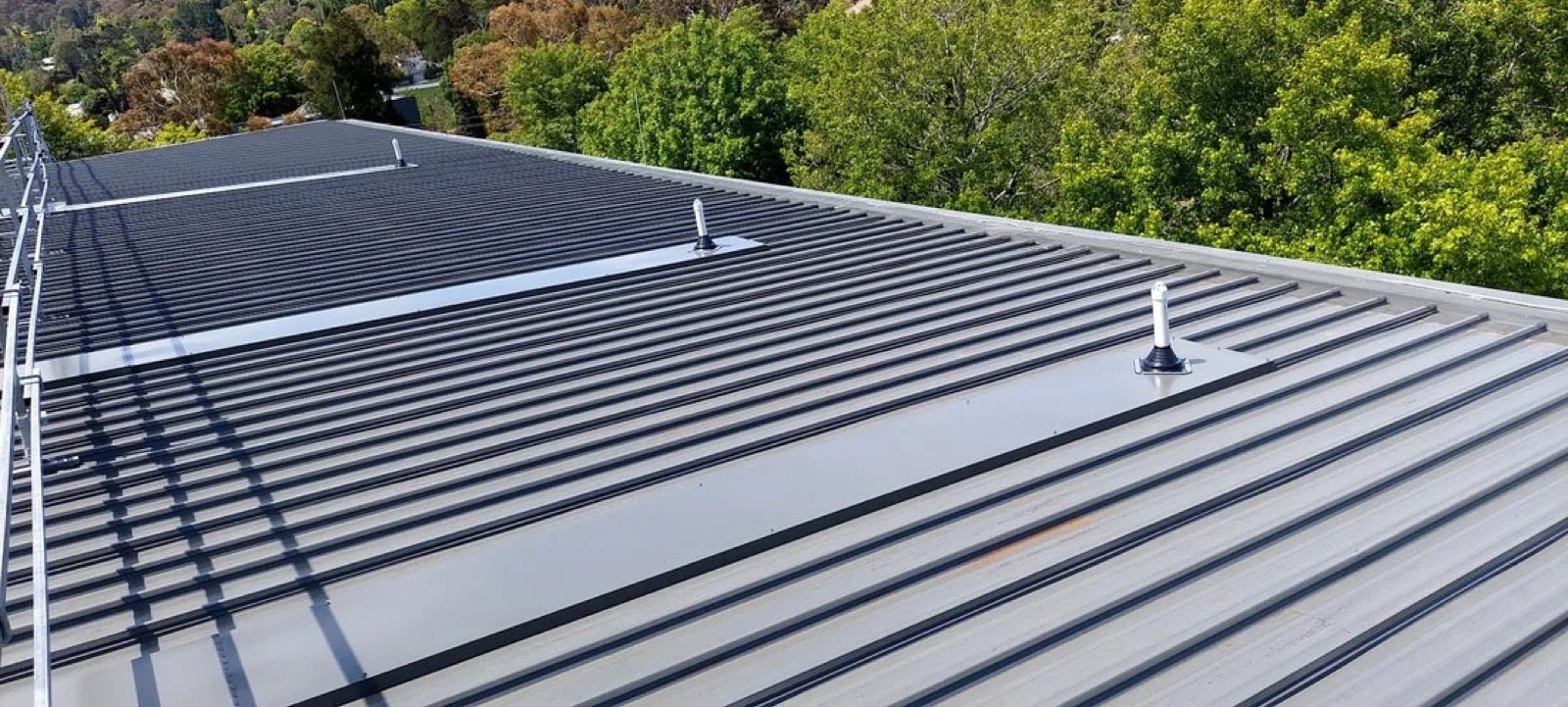
A silicone sealant for metal roof applications may be used around gutter seams, flashing, penetrations, trim or other exposed joints. But these details do not all seal in the same way. Some rely primarily on compressed tape, gaskets or mechanical fastening, while others use an exposed sealant bead to accommodate movement and keep water out.
That difference matters when choosing a product. The joint construction, metal and coating, expected movement, UV exposure, drainage conditions and paint requirements can all change which sealant chemistry is appropriate.
Once the joint and its role are clear, silicone, MS/SMP, polyurethane, butyl and acrylic systems can be compared on the properties that actually matter for that application.
Identify the Joint and Its Role
At this stage, the joint needs a precise name and a clear system role. Common candidates include gutter seams, end caps, inside or outside miters, outlets and downpipe interfaces, flashing and trim, penetrations, panel laps, fasteners, and transitions between different materials. The key question is what is the joint supposed to do?
| Joint observation | What the detail should establish | What a bead cannot replace |
|---|---|---|
| Gutter miter, end cap or outlet | Is the assembly still mechanically sound, and does its drainage path work? | A sealant bead cannot replace a loose connection, damaged metal or a persistent ponding condition. |
| Metal panel lap | Is the primary seal concealed and compressed within the named roof-system detail? | Every lap is an exposed gunnable-sealant joint. |
| Flashing return or trim edge | Is an exposed weatherseal specified, and what movement does the detail permit? | The trim, coating and adjacent membrane accept the same product. |
| Pipe, bracket or fastener penetration | Does the penetration detail rely on a gasket, washer, tape, boot or mechanical compression? | A topical bead alone is the primary long-term seal. |
| Dissimilar-material transition | Which two materials and finishes actually touch the bead? | “Metal” tells you enough about adhesion or staining. |
When the parts are not rigid, a fastener is missing, or the system detail has failed, the chemistry decision should wait. The assembly and drainage route need to be restored first. Sealant can be a weatherseal within a detail; it cannot replace the connection that keeps the detail in place.
Separate Concealed System Seals From Exposed Weatherseals
Some roof details are not designed around an exposed gunnable sealant in the first place. In one specific hydrostatic metal-roof context, the U.S. Department of Defense roofing guide requires the primary seal to be concealed in the joint and allows a hot-melt butyl formulation; it also prohibits silicone as that primary seal. That is not a rule for every roof, but it is a clear reminder to follow the actual roof-system detail rather than applying a generic exposed bead. UFC 3-110-03 also emphasizes continuity through panel terminations.
The diagram puts joint role, chemistry and product checks in one view.

For a concealed lap or penetration, the panel or accessory manufacturer’s detail should show the prescribed tape, gasket, fastener pattern, compression and termination treatment. For an exposed weatherseal, the bead should have a defined joint role and documented compatibility with the actual surfaces. For broader system choices, see Roofing & Facade.
Match the Chemistry to the Exposed Joint
Once the joint is genuinely an exposed weatherseal, the polymer family becomes useful. It explains the direction of the performance trade-off, but the product still has to match the joint, substrate and exposure.
The performance trade-off starts with the cured network. You do not need to become a polymer chemist, but you should know what each family is made to do:
| Chemistry | Why it behaves this way | Best fit and what to check |
|---|---|---|
| Silicone | A siloxane (Si–O–Si) backbone is moisture-crosslinked into flexible silicone rubber. The silicon–oxygen structure is comparatively stable under UV, ozone and temperature cycling; its low surface energy can make paint adhesion difficult. Acid/acetoxy systems release an acidic cure by-product, while neutral oxime or alkoxy systems use a different cure path. See Dow’s silicone chemistry overview and Soudal’s cure-system explanation. | For exposed, moving weatherseals where UV and temperature cycling matter, a controlled neutral-cure product is often the starting point. The useful checks are cure system, metal/finish, movement class and joint geometry, shrinkage or mass/volume change, weathered adhesion, water boundary and paintability. |
| MS/SMP | A silane-terminated polymer—often an organic polyether or polyurethane-related backbone—moisture-cures through its silane groups. The organic surface is usually easier to paint and can provide broad adhesion, but UV and oxidation resistance depend on the backbone, stabilizers, fillers and crosslink density. Sikaflex MS shows this product-level balance. | MS/SMP tends to move higher when paintability or a broader substrate range matters. The data should cover the actual coating and paint system, UV and chalking, cure conditions and a project sample. |
| Polyurethane | In common one-part products, moisture reacts with an isocyanate-terminated prepolymer to form a urethane/urea network. That organic network can provide tough, tear-resistant cohesion and paintability, while cure depth, humidity and UV stabilization influence the result. Sikaflex Construction Sealant is one product example. | A named PU may fit when toughness, paintability or a documented water-service scope matches the detail. Its TDS should cover UV, cure depth, paint, preparation and water service. |
| Butyl | Many butyl tapes and non-curing butyl sealants remain viscoelastic and tacky instead of forming a hard chemical cure. Under continuous compression they can cold-flow into small voids and act as a gasket. TEROSON RB II is a concealed-tape example. | Butyl belongs where the named detail calls for a concealed, mechanically compressed and continuously supported seal. Compression, exposure and termination govern; permanent tack does not replace an exposed weatherseal bead. |
| Acrylic | Common water-based acrylic sealants form a film as water leaves and the particles coalesce. That makes them easy to paint and clean up, but water loss creates a higher shrinkage risk and the cured film generally tolerates less exterior movement than an elastomeric silicone or hybrid. SikaSeal-176 is one product example. | Acrylic is generally reserved for a controlled, lower-movement detail with documented exterior exposure. For thermally moving metal-roof or gutter joints, shrinkage, movement, weathering and water limits are the deciding checks. |
For metal roofing and gutters, “silicone” is not a quality grade. Acid-cure or acetoxy silicone is generally avoided on iron or other corrosion-sensitive metal unless the exact manufacturer documentation supports it: the acidic cure by-product can attack a susceptible surface or weaken the bond. Neutral-cure describes the cure path, not the quality of the formulation. The supplier should be able to state shrinkage or mass/volume change, weathered adhesion and TDS/batch control; poorly controlled products can lose volatiles or allow additives to migrate, leading to shrinkage, cracking, staining or adhesion loss.
MS/SMP should be screened for weathering, not only for paintability. Its organic backbone may chalk or lose surface integrity sooner than a well-formulated exterior silicone when UV and oxidation resistance are not supported by the product data. Acrylic deserves an even stricter screen for shrinkage and exterior weathering; for a thermally moving metal-roof or gutter joint, it is usually not the first chemistry to evaluate.
Do not use sealant selection to compensate for persistent ponding on a roof or gutter. Even a product with a continuous-immersion test does not make a ponded assembly acceptable. If water remains over the joint, inspect the slope, outlet, blockage, overflow path and system detail first, then correct the drainage problem. Long-term immersion may be a separate, named requirement in another type of system; it is not a default roof or gutter service condition.
In our experience, both silicone and MS/SMP can work in gutter and metal-roof applications. When UV and weathering dominate, we usually start by checking a weather-resistant silicone. When the project must be painted or includes a wider mix of substrates, an appropriate MS/SMP product moves higher on the list. The actual coating, joint and product data still decide.
Approve the Substrate, Exposure and TDS Evidence
The approval file should identify more than “aluminum” or “metal roof”: the base metal, surface condition and exact coating or finish; the cleaner and primer; joint geometry and anticipated movement; water and UV exposure; paint requirement; existing sealant, tape or gasket; and the product TDS revision.
ASTM C920 is useful because its designation combines type, grade, class and use. For a metal-roof sealant, that classification is one part of the product evidence, not approval for every coating, joint geometry or installation. The same file should note actual metal/finish adhesion evidence, any named water-service scope, staining risk for porous adjacent surfaces, application and cure conditions, joint width/depth, tooling and old-sealant treatment.
Unknown old material deserves its own check before over-application. A coating, membrane or old sealant can control compatibility even when the base metal looks familiar, so removal, cleaning, primer and a representative sample may determine the next step.
Turn a Shortlist Into a Project Approval
Once the joint, substrate and exposure are clear, evaluate a specific product. WR550 Weather-Resistant Silicone is Vesta’s one-component, neutral-oxime weather-resistant silicone for compatible exterior roofing details, UV exposure and movement joints.
Against the criteria above, several WR550 properties are worth checking: ±35% movement capability for correctly designed joints, 0.6 MPa modulus at 100% elongation, approximately 40 Shore A hardness, 93% elastic recovery, non-sag behavior and conditioned adhesion after water and UV exposure on the tested substrates. Together, they describe a product intended to keep its shape, carry repeated joint movement and retain its bond through the tested weather conditions. The approximately 350% elongation-at-break value is a tensile-specimen result, not a substitute for the declared movement class or joint geometry. That combination makes WR550 worth evaluating for compatible, non-immersed exterior joints where movement and weathering matter; it is not approved for permanent immersion, structural glazing, every roof membrane or every coating.
The approval package should include:
- joint photographs or a section/detail, plus width, depth and expected movement;
- roof or gutter system and the named lap, penetration, fastener or drainage detail;
- base metal, finish/coating, surface condition, cleaner and proposed primer;
- UV, temperature-cycle, intermittent-water, ponding and maintenance conditions;
- paint requirement, existing sealant/tape/gasket and the target market;
- product identity, TDS revision, sample requirement and any project test or acceptance method.
This is also the right point to ask whether a different chemistry or system detail should replace the initial idea. A robust answer is sometimes a neutral-cure silicone, sometimes a suitable MS/SMP or polyurethane, and sometimes a tape, gasket, mechanical correction or the roof-system manufacturer’s own detail.
FAQ: Can silicone sealant be used on a metal roof?
Silicone can suit a compatible exposed weatherseal where the exact product supports the metal/finish, weathering and joint-movement conditions. WR550 is worth evaluating when those criteria fit; concealed laps, permanently ponded water and assemblies needing mechanical repair still call for the system detail first.
FAQ: Is “silicone gutter sealant” enough to specify a gutter repair or project product?
No. The phrase does not identify the joint, drainage condition, base metal, coating, existing material or the system detail. For B2B approval, those inputs come before the chemistry and exact product name.
Request a joint-to-approval review
Send the joint detail and dimensions, base metal and coating, roof or gutter system/detail, exposure and ponding conditions, paint requirement, existing sealant/tape/gasket, target market and the TDS, sample or test you need. Request a sample and application-support review so we can identify whether WR550 is suitable to evaluate or whether a different system detail or chemistry needs attention.